Few partnerships define a sport the way Adidas defined German football. For seventy years, their connection represented more than sponsorship, it was national identity stitched into fabric. In this article, we examine how sentiment gave way to strategy, and why Germany’s switch to Nike marks not just the end of an era, but the beginning of a new sponsorship paradigm.
Germany’s football community was stunned in March 2024 when the German Football Association (DFB) announced that Nike will become the new official kit supplier of all German national teams starting from 2027 to 2034. The new deal means the end of a relationship with Adidas that dates back all the way back to the 1950s. In fact, the decision marked the conclusion of one of the longest-running partnerships in sports, namely, a 70-year association during which Germany lifted, amongst others, four men’s World Cups, in the Adidas kit. For decades it had been assumed that the national team’s jerseys and Adidas’s three stripes were a match made in heaven. However, in a wake up call for modern sports’ economic realities, the DFB chose to cut this historic tie, after an offer from the highest bidder knocked at the door. The DFB stated Nike’s superior financial package and strategic commitments to German football development as the main drivers behind its decision. However, this move, while financially sound, sparked intense debate in Germany about the importance of tradition, loyalty, and the changing dynamics of sports sponsorship.
Year
Milestone
1954
”Miracle of Bern”: West Germany wins the World Cup in Adidas boots
1974
Germany hosts and wins the World Cup in Adidas
1990
Reunified Germany wins the World Cup
2014
Germany wins its fourth World Cup in Adidas
2018
Deal extended through 2026
2024
DFB announces Nike from 2027
2027
Nike officially takes over
Below Vinciamo explores the aforementioned in detail.
A Partnership Built on History and Identity
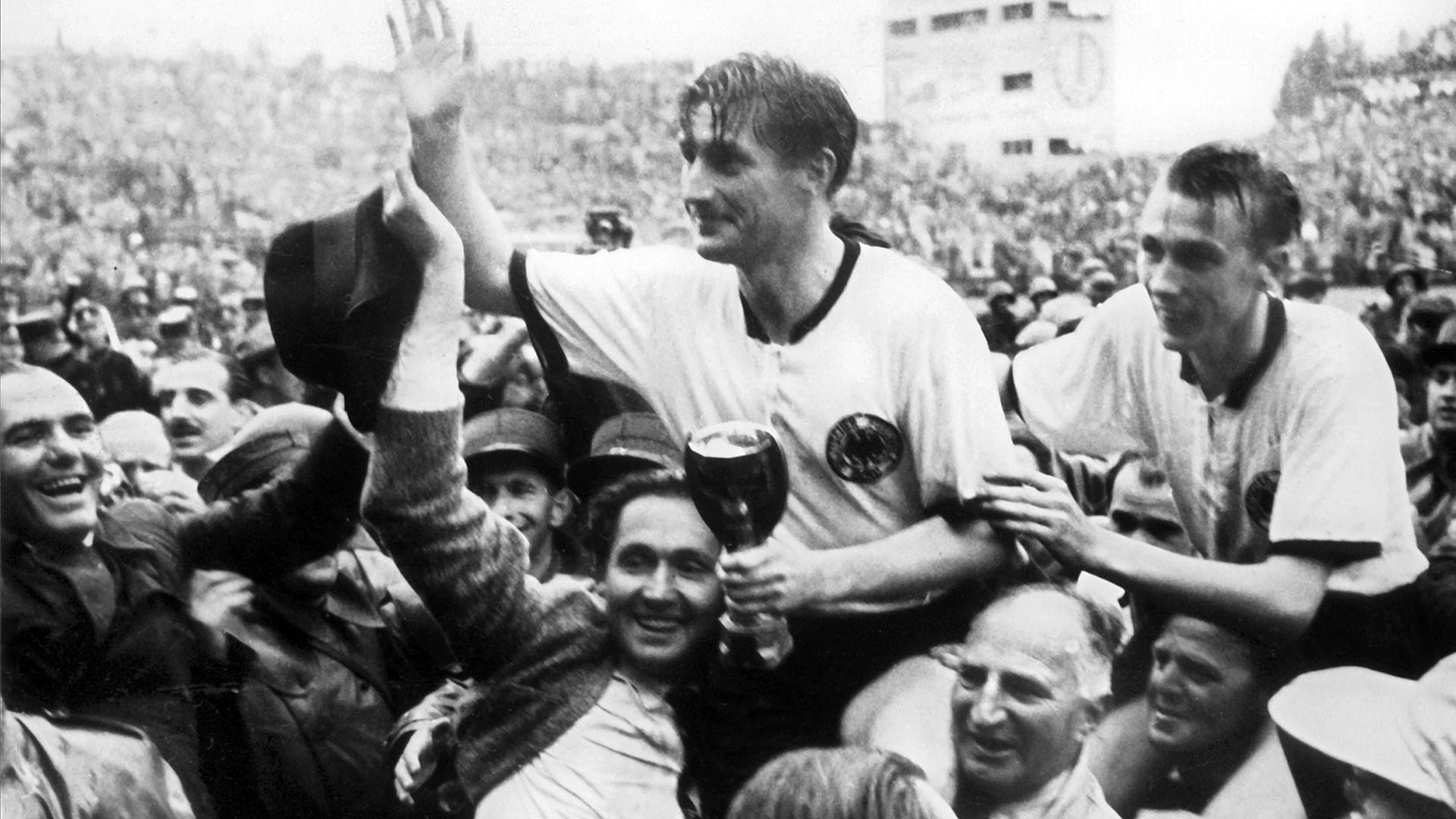
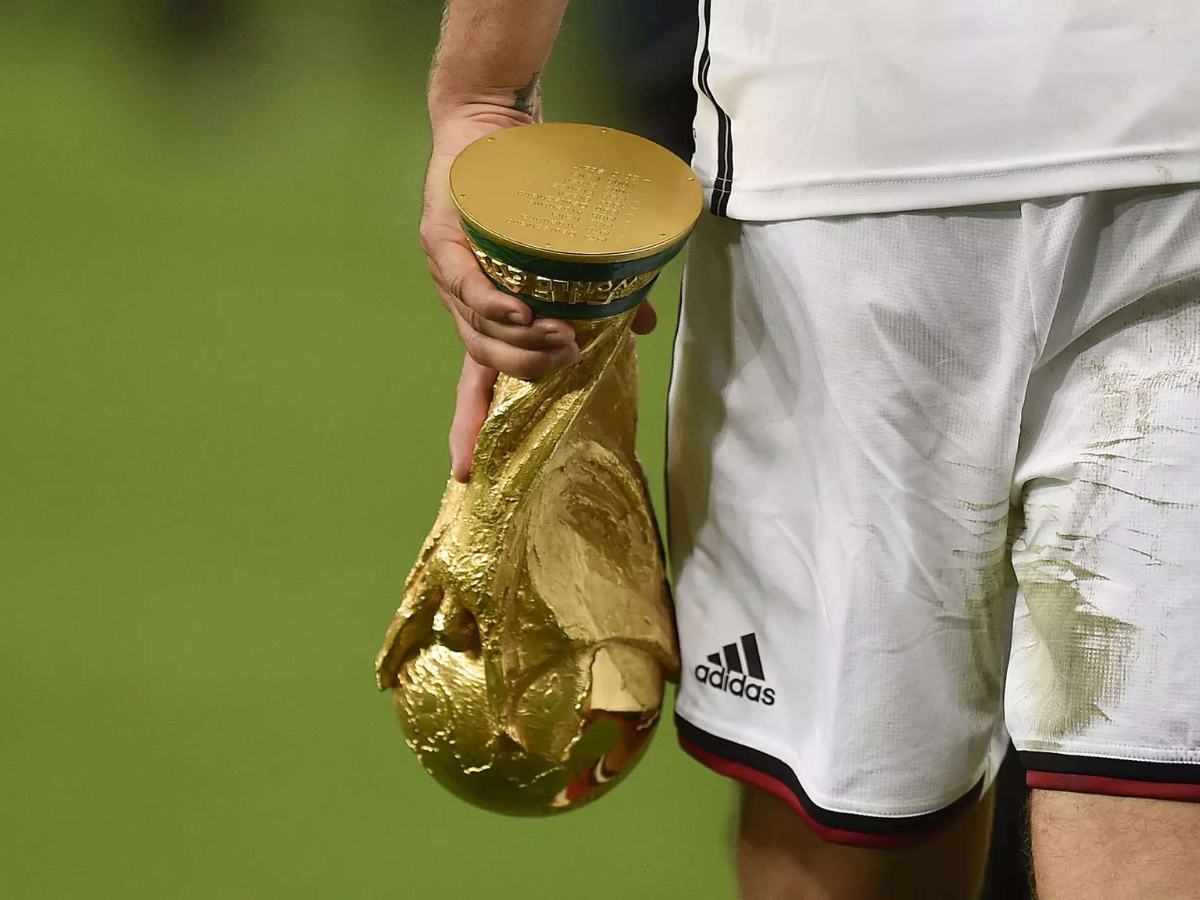
In order to appreciate the importance of this change, one must firstly understand how deeply Adidas is intertwined with German football history. Adi Dassler, who created Adidas, was present when West Germany won its first World Cup in 1954. In fact, the team wore his company’s innovative boots with screw-in studs. That triumph in Bern or more commonly known to football fans as “the Miracle of Bern” was the beginning of an journey of Adidas and the DFB that endured through generations.
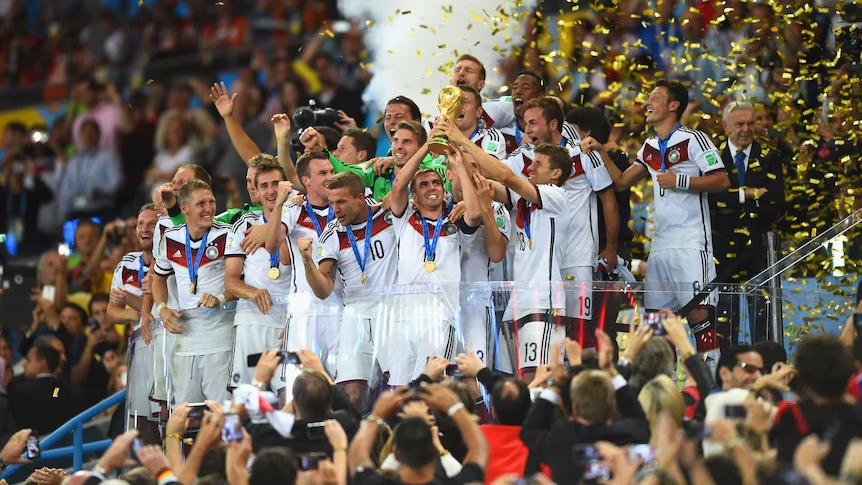
From those black boots in 1954 to today’s advanced jerseys, German teams have worn Adidas for every big win, including 4 World Cups (1954, 1974, 1990, 2014) and 3 European Championships. Also, the women’s national team has secured two World Cups and eight European titles in Adidas gear.
Over time, the three stripes became a national symbol, just like the German flag. This partnership wasn’t just simply about clothing; it symbolized national pride and for Adidas it became part of its corporate identity. Adidas, headquartered in Bavaria, had a sense of “home” advantage, a German brand supporting Germany’s teams. The relationship often appeared unshakeable. But this was not be so.
Even until most recently, it seemed like an impossibility for many fans to think of Germany wearing anything but Adidas. The DFB and Adidas often reaffirmed their commitment, most recently in 2019, extending the deal through the 2022 World Cup and later to 2026. With the most recent Euro 2024 (hosted in Germany), Adidas was not only supplying the kits but also hosting the German team at its headquarters as a base camp, showing how close they were.
This made the announcement of a new sponsor even more surprising.
However, ultimately, sports sponsorships are business partnerships, and no matter how storied, they are subject to change when conditions evolve. The DFB’s historic bond with Adidas, while rich in sentiment, had to be weighed against the federation’s future needs and the shifting landscape of the sports industry.
By 2024, German football found itself at a crossroads that would have seismic repercussions: Either stick with tradition and history, or embrace a new alliance that is promising unprecedented financial and strategic support.
Nike’s Winning Bid: Money and Vision Outweigh Tradition
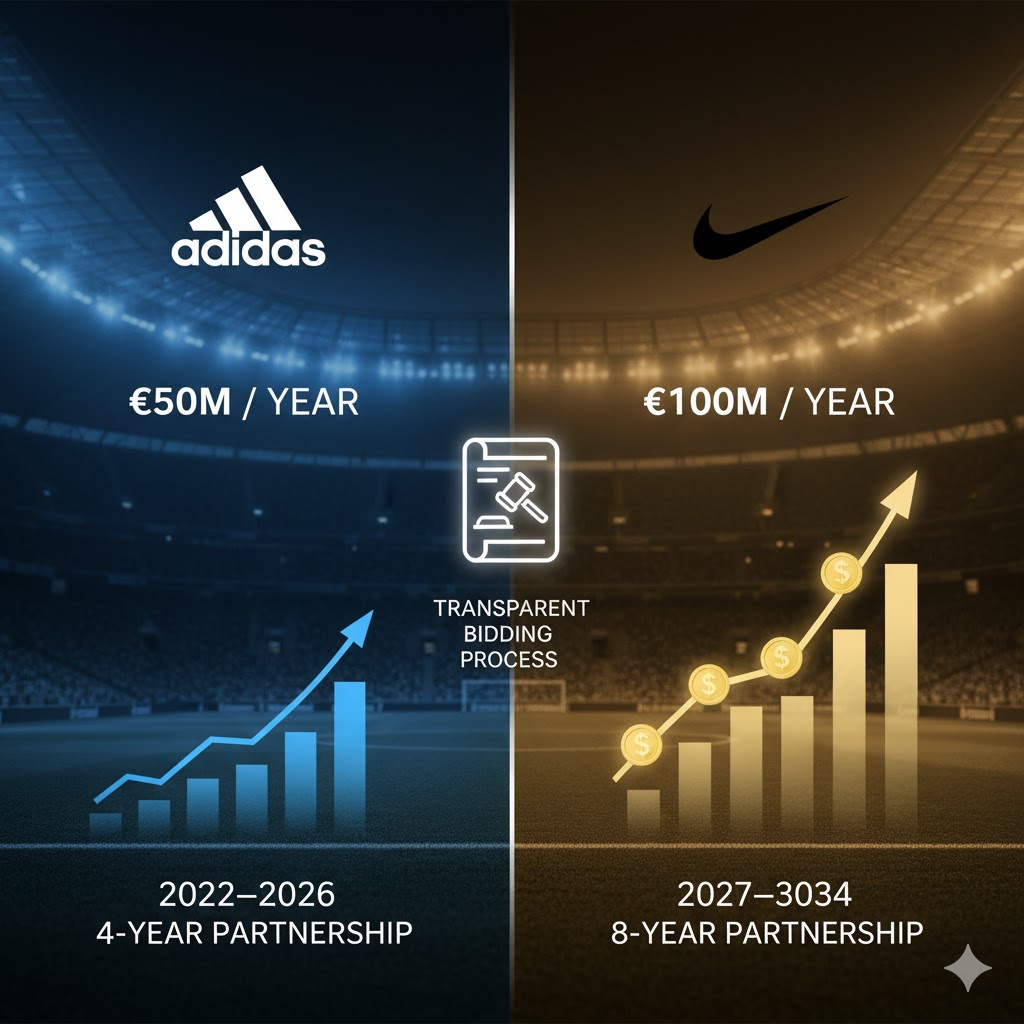
When the DFB opened a competitive tender for its next kit sponsorship, it set the stage for a monumental bidding war, one, that as we know, Nike decisively won with an astronomic offer. While exact figures have not officially been disclosed by the DFB at the time, reports in the German press gave a good foundation to speculate on the scale of Nike’s unrefusable offer. Nike reportedly agreed to pay around €100 million per year, which is roughly double what Adidas had been paying (approximately €50 million per year). This represents a critical financial boost for the DFB, and is also making it one of the highest kit deals ever to be signed in international football. Following the signing, the DFB officials made it clear that Nike’s bid was “by far the best financial offer” among the contenders, which at this point seems to be a slight understatement.
However, Nike’s pitch was not just about writing a bigger check. In fact, the American sportswear giant merged its offer with a strategic vision for German football development that apparenty seems to have aligned with the DFB’s priorities. Holger Blask, the DFB’s chief executive for marketing, noted that Nike impressed not only with financial strength but also with “a clear commitment to the promotion of amateur and grassroots sports as well as the sustainable development of women’s football in Germany”. In other words, Nike pledged support for the very foundations of the sport, from local youth leagues and volunteer-run clubs all the way up to the women’s national team, areas the DFB has been struggling with in the past. This broader commitment likely sweetened this already enticing deal for a federation that has faced pressure to invest more in grassroots and women’s programs.
Ultimately, the DFB leadership framed the choice as a forward-looking, strategic investment in the game’s future. DFB President Bernd Neuendorf stated that the Nike partnership would enable the federation to “carry out key tasks in the coming decade with regard to the comprehensive development of football in Germany”. Stephan Grunwald, the DFB treasurer, underscored that the infusion of resources means “an economically stable future” for the association.
The subtext was clear. The windfall from Nike will be funneled into strengthening German football at all levels, something the DFB argued it could not ignore. With over 24,000 clubs, 2.2 million active players, and thousands of volunteers and referees under its umbrella, the DFB emphasized its responsibility to the domestic game. In its public communications, the federation noted that those vast grassroots operations are largely self-financed by the DFB and that it must make hard economic decisions to sustain them.
Key Factors in the DFB’s Decision
An unmatched Financial Offer: Nike’s bid was miles away from the competition. At around €100 million per year, it dwarfed Adidas’s previous €50 million annual payout, providing a critical financial boost to the DFB’s finances. This kind of income is undoubtedly a game-changer for funding infrastructure, coaching, and development programs.
Grassroots and Women’s Football Investment Promise: Nike presented a cleverly drafted development plan. The DFB was impressed by Nike’s “substantive vision” to invest in amateur clubs, youth academies, and women’s football nationwide. Such commitments gave way for a partnership that goes beyond just pretty jerseys of the senior men’s team. More importantly they were aligning with the DFB’s mission to grow the game inclusively.
Long-Term Partnership equals Stability: The long-term agreement with Nike spans eight years (2027–2034), and covers multiple tournaments (Euro 2028, World Cup 2030, Euro 2032, etc.). This long-term horizon provides financial security and a stable planning for DFB’s projects. By contrast, sticking with Adidas was not securing a similar level of funding for the future.
A Transparent Bidding Process: The DFB conducted an open, “transparent and non-discriminatory tender process” for the deal. This meant that, sentimentality aside, the federation was legally obliged to evaluate all offers objectively and fairly. Once Nike came in with a better (in all aspects) proposal, the DFB was institutionally and legally compelled to take it into consideration. Loyalty was not enough.
Tender process requ.
Decision factor
Nike offer
Adidas status
Financial package
est. €100m per year, clearly the highest bid
est. €50m per year
Contract length
8 years (2027-2034), long-term stability
Current deal ends 2026
Grassroots investment
Explicit commitment
Less emphasized
Women’s football
Part of the proposal
Existing, but not a differentiator
The tender process required that the best offer wins. Legacy alone was not enough.
Backlash at Home: Tradition vs. Commerce
The announcement that Germany would drop Adidas gear triggered swift and fierce backlash, reaching far beyond sport. Many saw it as a break with national tradition. Politicians across the spectrum condemned the DFB’s move as a blow to German identity and economic patriotism.
Vice Chancellor Robert Habeck lamented, “I can hardly imagine the German jersey without the three stripes,” calling Adidas and black-red-gold “a piece of German identity.” He wished for “a bit more local patriotism” in the decision. Health Minister Karl Lauterbach agreed, calling it “a wrong decision where commerce destroys a tradition and a piece of home” .
Bavarian premier Markus Söder, from Adidas’s home state, was particularly vocal: “The national team always plays in the three stripes of Adidas. That was as clear as the ball being round and a game lasting 90 minutes.” He called the split “wrong, a shame and incomprehensible,” warning that football must not become “a pawn in international corporate battles”.
Stakeholder group
Dominant tone
Federal politicians
Negative
Bavarian and state leaders
Strongly negative
Fans (general)
Mixed
DFB leadership
Justifying, pragmatic
Industry and sponsors
Mostly positive
Amid the uproar, the DFB moved to explain itself. “We understand every emotion,” it wrote on social media, calling the end of a 70-year partnership “a drastic event” that “doesn’t leave us cold”. Still, it stressed that its first duty is to the game in Germany itself, funding thousands of clubs and millions of players. “Against this background (of circumstances), the DFB has to make economic decisions,” it said, noting that Nike “made by far the best financial offer in a transparent process.”
The DFB’s balancing act, honoring nostalgia while defending pragmatism, captures the core tension. National teams embody heritage and pride, yet modern sport runs on global competition and revenue. The debate over “die Mannschaft” shows how even a jersey deal can ignite questions of identity, economics, and national loyalty.
Adidas’s Reaction: Business Logic in the Face of Loss
Losing the German national team kit deal was a symbolic blow for Adidas, though not necessarily a financial one. The company’s official response in March 2024 was measured. It acknowledged the DFB’s decision, pledged to honor its contract through 2026, and avoided public confrontation. This restraint reflected both professionalism and pragmatism, as Adidas remains a DFB sponsor until the partnership ends.
Behind the scenes, CEO Bjørn Gulden made clear that Adidas had chosen not to enter a bidding war it deemed excessive. A month later, he explained that Adidas remained interested in major football sponsorships “but only if the price is right.” Nike’s reported €100 million-per-year offer was, he said, “inexplicable” given Adidas’s valuation of the deal. Gulden emphasized financial discipline over sentiment, insisting that Adidas would “not go any further” than what it considered justified, even for Germany.
The reasoning was straightforward. National teams generate less consistent sales and visibility than top clubs. Fans buy club jerseys annually, while national team sales spike mainly around major tournaments. “National team football isn’t everything,” Gulden noted, pointing to the far greater exposure from club partnerships with Real Madrid, Manchester United, Arsenal, and Bayern Munich .
Variable
Adidas view
National team jersey sales
Lower than club jerseys; hard to justify €100m per year
Match frequency
Lower for national teams; less recurring visibility
Current financial position
2023 loss posted; more cost discipline
Competitive stance vs Nike
Selective, not reactive; won’t chase at any price
Adidas’s caution was also shaped by its 2023 financial loss, its first in over 30 years, partly due to the costly Yeezy exit. Gulden’s approach reflects a shift toward fiscal prudence and away from ego-driven competition with Nike.
Strategically, Adidas has been reallocating investments. In 2022, it replaced Puma as Italy’s kit supplier in a deal worth about €35 million per year, roughly one-third of Nike’s offer to the DFB. Like Puma before it, Adidas chose to pay only what its business case supported. Such discipline signals that while Germany was historically central to Adidas’s identity, the company now prioritizes commercial logic over sentiment.
Looking ahead, Adidas plans to celebrate its 70-year partnership with the DFB before handing over to Nike in 2027. It will lean on nostalgia while refocusing on other assets, including Argentina, Spain, Belgium, and Italy and perhaps new opportunities like France after its contract runs out in 2034. Losing the German jersey is painful but not defining; Adidas remains a dominant force in global football, now guided by strategy, not emotion.
Implications: A New Chapter for Sponsorships in Global Football
The Germany kit deal saga is more than just a single sponsorship change, it’s a bellwether for larger trends in the sports industry. For sports industry professionals and observers, several key insights and questions emerge from this development:
1. No Partnership is Sacred
The end of the DFB–Adidas partnership underscores that in today’s global sports business, tradition alone cannot guarantee a sponsorship deal will continue. Even 70-year of shared history and immense success, will yield to the market when the financials made available are compelling. Going forward, we may see other long-standing sponsorships tested if challengers are willing to put significantly more on the table.
2. Escalating Value of Top Properties
The financial bar for sponsoring elite national teams is rising sharply. Germany’s prospective €100 million-per-year deal is unprecedented in international football.
Federation
Supplier
Term
Germany
Nike
2027-2034
France
Nike
2024-2034
Italy
Adidas
2023-2027
Brazil
Nike
2027-2038
Argentina
Adidas
2011-2022
3. Strategic Plays in the Battle of the Brands
Nike’s capture of the German team highlights the intense duel between Nike and Adidas for global football supremacy. Each sees key national teams as strategic assets for brand positioning.
4. Holistic Partnerships go Beyond the Kit
One notable standout of the DFB’s decision was Nike’s emphasis on supporting amateur and women’s football. This indicates a broader trend where sponsors are expected to contribute more than just money and equipment to the flagship team.
5. Public Sentiment and Brand Image Risks
Changing a beloved sports sponsorship can trigger backlash. Nike will need to localize its messaging and deliver on grassroots promises to win over German sentiment.
With Every Ending comes a New Beginning
The German national team’s switch from Adidas to Nike illustrates the evolving dynamics of sports sponsorships. It’s a story of how heritage and nostalgia collided with financial might and forward-looking strategy, and how the latter won out in a landmark decision. In practical terms, the deal gives the DFB resources and partner support that could fuel its ambitions to rejuvenate German football after some lean years on the pitch. For Nike, it is a marquee victory, capturing one of the last big prizes in football sponsorship and sending a message to the industry about its intent to lead. For Adidas, it’s an opportunity to regroup and reinforce its strategy, focusing on properties where it sees the greatest value and return.
Moving forward, the fallout from this deal will be watched closely.
Will Germany’s performance or popularity be affected by the change in kit supplier? Unlikely on the field, but fan merchandise sales and public sentiment will reveal themselves once the Nike kits arrive.
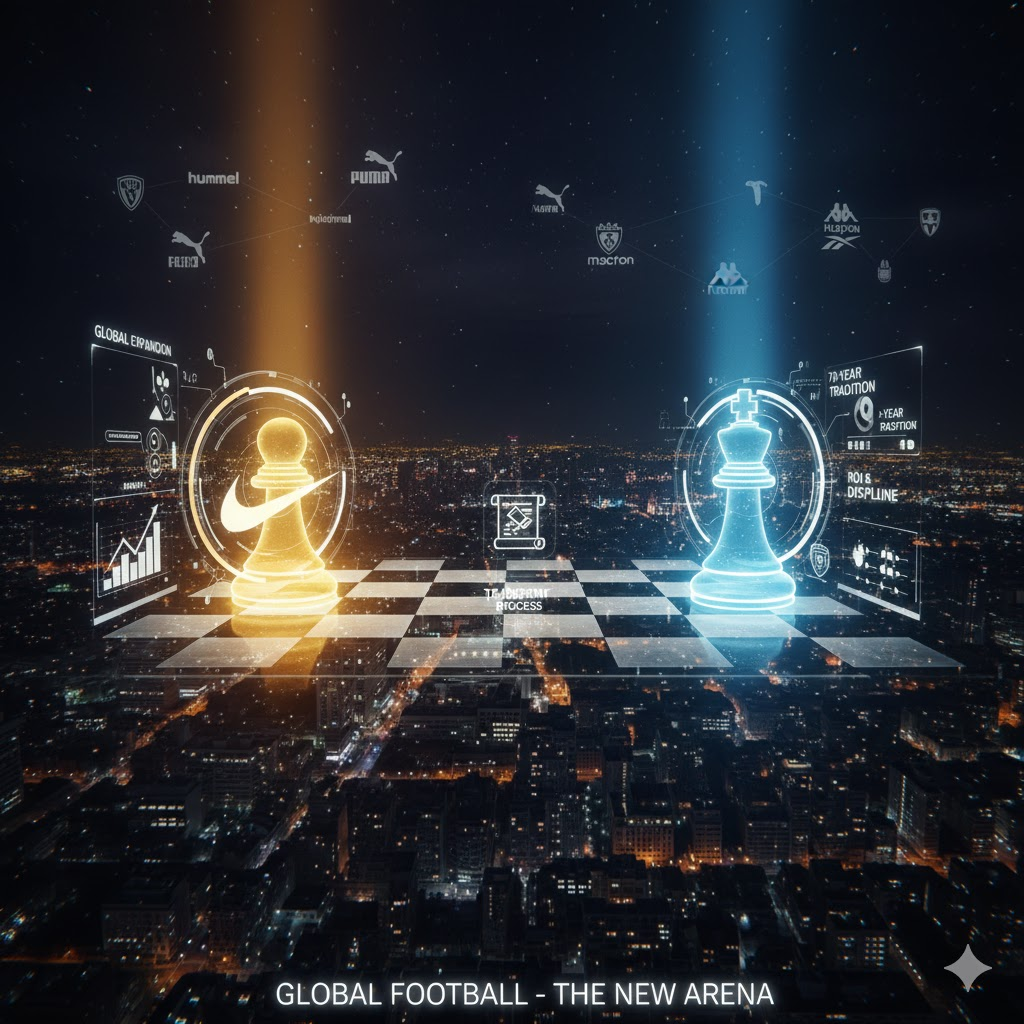
Will Adidas attempt to strike back by courting other federations or doubling down on club deals? Almost certainly, the global chess match for supremacy between the big brands will continue.
And will other federations put their long-term partners to the test? Very possibly, as executives weigh if they too can reap a windfall by opening the doors to a new sponsor.
In the end, German football’s leap from Adidas to Nike signifies a new chapter in the economics of sport. It shows that even the most storied partnerships must eventually justify themselves in the ledger books, and that global companies are eager to step in when an opportunity arises. While some fans mourn the loss of an icon on the German jersey, the reality is that the value of that jersey has never been higher. The coming years will reveal how this influx of sponsorship capital shapes the fortunes of the DFB and whether this bold bet by both the federation and Nike pays the dividends they hope for.
One thing is certain though; the ripple effects of this deal will extend far beyond the sewing of a different logo on a shirt, potentially redefining how sponsorships are approached in football and beyond. The game, to quote the old saying, may last 90 minutes, but the business of the game is now a 24/7, high-stakes contest where only the fittest (and the savviest) survive.
Sources & Content
The information and quotes in this article are drawn from reputable sports news and industry sources and official statements found online. Reactions from German political figures were cited from offical public media. Comments and financial figures were reported from public sources. These sources provide a factual basis for analyzing the sponsorship change and its implications. AI-paraphrasing and generation of visuals has been applied. Logos were shown for editorial purposes only. No affiliation implied.
Disclaimer
This article is intended for informational and analytical purposes only. The views expressed reflect professional interpretation and opinion based on publicly available information at the time of writing. While every effort has been made to ensure accuracy, Vinciamo Sports makes no guarantees regarding the completeness, timeliness, or reliability of the data presented. This content should not be regarded as financial, legal, or strategic advice, and Vinciamo Sports accepts no liability for decisions made based on this material.
A. Strulak writes on sports business, commercial strategy and the economics of rights. Vinciamo Sports, Sport. Reimagined.